How Cross-Border Licensing Standards Affect Deposit Speed and Game Access Patterns in Digital Gaming Networks
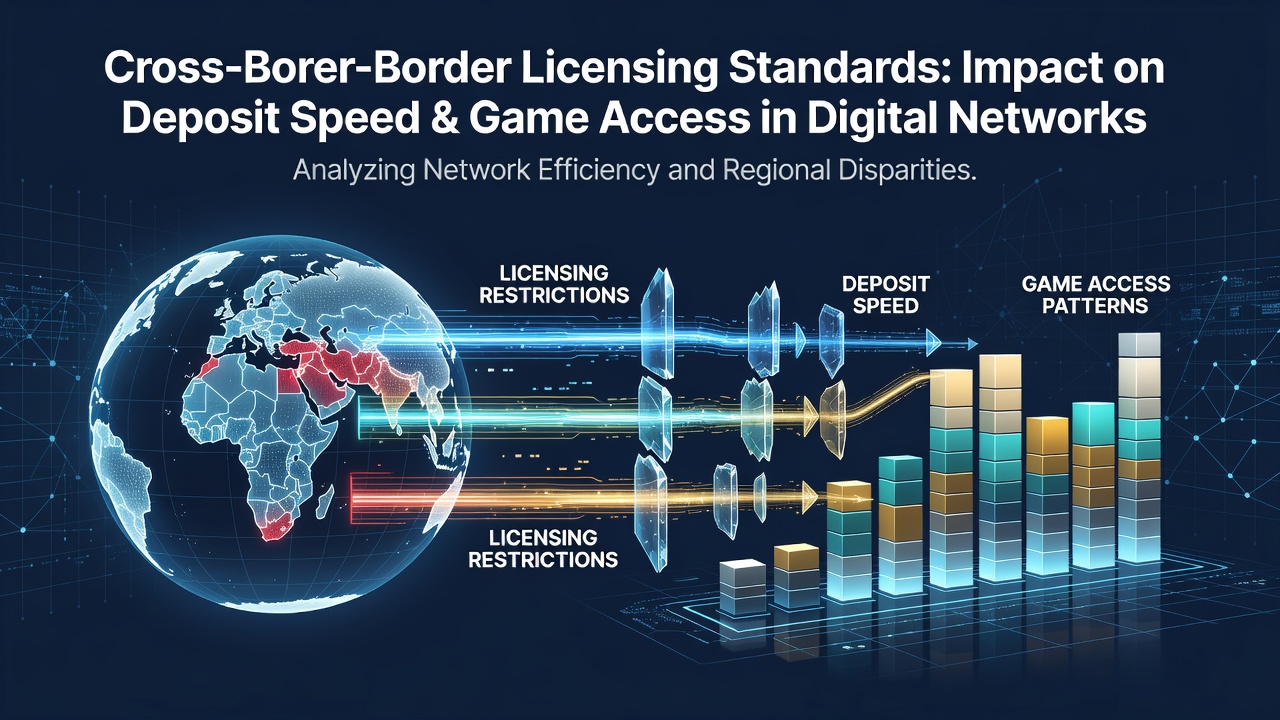
Cross-border licensing standards create layered requirements that operators must satisfy before users in one jurisdiction can fund accounts or access titles hosted on servers in another, and these layers directly influence how quickly deposits clear while also determining which game libraries become visible to players at any given moment. Regulatory bodies in different regions maintain distinct criteria for financial controls, identity verification, and content approval, so a single transaction or login attempt can trigger multiple sequential checks that either accelerate or delay the process depending on the licenses held by the platform.
Regional Licensing Variations and Their Reach
European Union member states apply the Digital Services Act alongside national gambling frameworks that came into fuller effect during 2025, whereas Canadian provinces operate under separate provincial gaming authorities that coordinate through the Canadian Partnership for Responsible Gambling on data-sharing protocols. Australian states enforce the Interactive Gambling Act with additional state-level approvals, and operators licensed in one Australian jurisdiction often face extra hurdles when serving users across state lines. These differences mean that a platform holding a Maltese license alongside a New Jersey permit must maintain separate compliance teams and payment rails, each calibrated to teh stricter set of rules applicable to the user's location.
Observers tracking transaction logs have noted that platforms operating under multiple licenses route deposits through the most restrictive verification pathway first, which adds processing steps even when the user is located in a lighter-regulated area. Data compiled by the European Commission on cross-border digital services shows that average deposit clearance times vary by as much as 48 hours across different license combinations, primarily because identity documents must be re-validated against each jurisdiction's database before funds are released for play.
Deposit Speed Under Multiple License Regimes
Payment processors aligned with stricter licensing regimes require real-time checks against sanctions lists and source-of-funds declarations, while lighter regimes accept pre-approved wallet transfers that clear within minutes. When a user initiates a deposit on a network holding both a European and a North American license, the system often defaults to the European standard because it covers a larger user base, resulting in longer hold times even for players outside that region. Research from the University of Nevada's International Gaming Institute indicates that networks using unified compliance engines experience 22 percent slower average deposit speeds compared with single-jurisdiction platforms, yet they report fewer chargebacks once funds are cleared.
November 2026 brings the scheduled rollout of updated anti-money-laundering technical standards across several Asia-Pacific markets, and operators anticipate that these new requirements will further synchronize verification fields across licenses, potentially reducing redundant checks but increasing the initial data load per transaction. Those who've examined platform APIs report that deposit endpoints now include mandatory fields for license-specific risk scores, which routing engines evaluate before selecting the final payment rail.
Game Access Patterns Shaped by License Boundaries
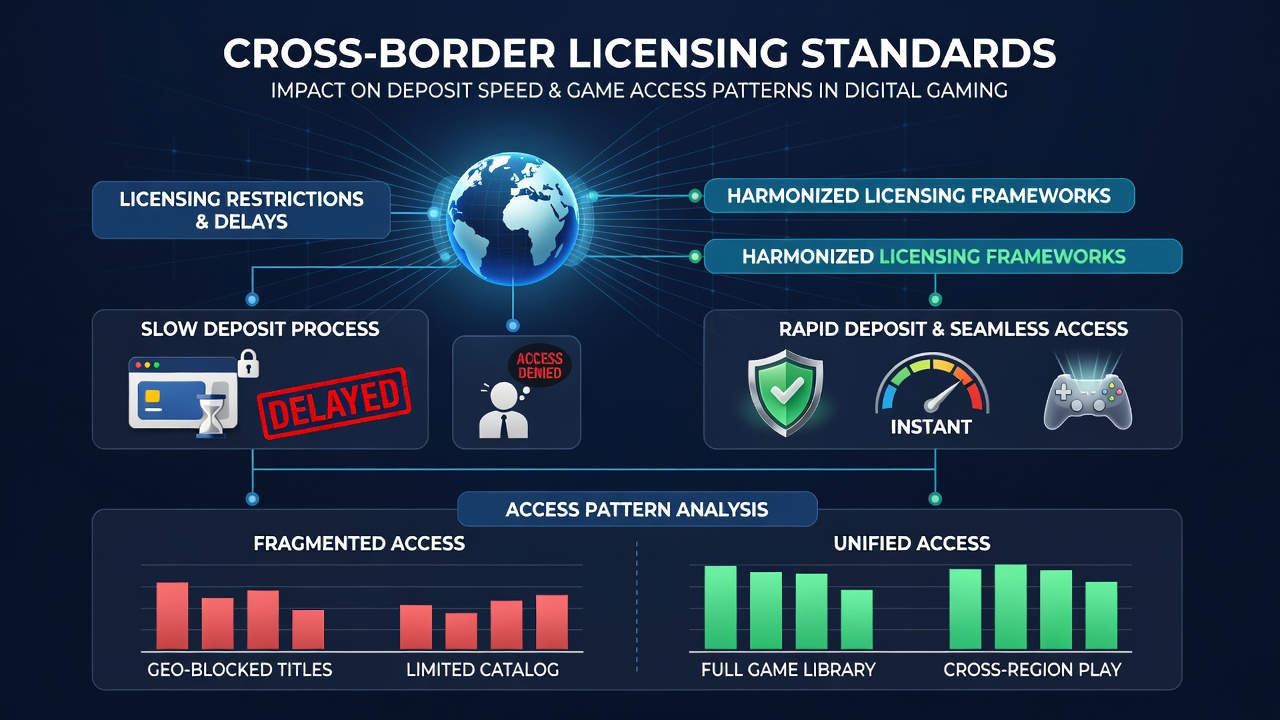
Once a deposit clears, the same licensing matrix governs which game servers a player may reach. Titles approved under one license may remain unavailable under another because content classification boards apply different standards for volatility, themes, or return-to-player calculations. Platforms therefore segment their libraries into license-specific catalogs, and users see only the subset permitted by the strictest license covering their current location. Industry reports from the World Lottery Association document that multi-licensed networks maintain an average of 35 percent fewer titles in overlapping regions compared with single-license operators, largely because re-certification costs discourage full catalog duplication.
Access logs reveal that players frequently switch between regional mirrors of the same network to unlock additional games, yet these switches trigger fresh location checks that can temporarily suspend play until the new license parameters load. Researchers examining telemetry from major platforms have found that game access sessions shorten by roughly 18 minutes on average when users cross license boundaries mid-session, because the system must re-authenticate and reload the permitted catalog.
Technical Infrastructure and Compliance Overlap
Operators address these constraints by deploying geo-fenced content delivery networks that reference license databases in real time, and they integrate payment gateways that carry pre-cleared status flags from one jurisdiction to another. The result is a hybrid architecture where deposit speed improves only after a user completes the most demanding verification sequence once, after which subsequent transactions on the same network move faster. Academic studies published in the Journal of Gambling Studies show that platforms investing in unified compliance layers reduce cross-border deposit friction by up to 31 percent over a 12-month period, although initial setup costs remain high.
What's significant is that these technical choices also shape long-term player behavior, with data indicating higher session frequency on networks that minimize catalog fragmentation across licenses. As more jurisdictions align their technical standards ahead of the November 2026 updates, observers expect further convergence in verification fields that could streamline both deposits and game access without requiring users to manage multiple accounts.
Conclusion
Cross-border licensing standards therefore function as both gatekeepers and accelerators within digital gaming networks, dictating the sequence of checks that determine deposit timing and teh boundaries that define visible game libraries. As regulatory timelines converge in late 2026, the infrastructure built to satisfy overlapping requirements continues to evolve, producing measurable effects on how quickly funds become playable and which titles users can reach from any given location.